
GUIDE · COMPARISON
Steel vs stick-built
We build steel, and we are not going to pretend stick-frame is bad construction. It is not. Here is the honest version of where each system wins.
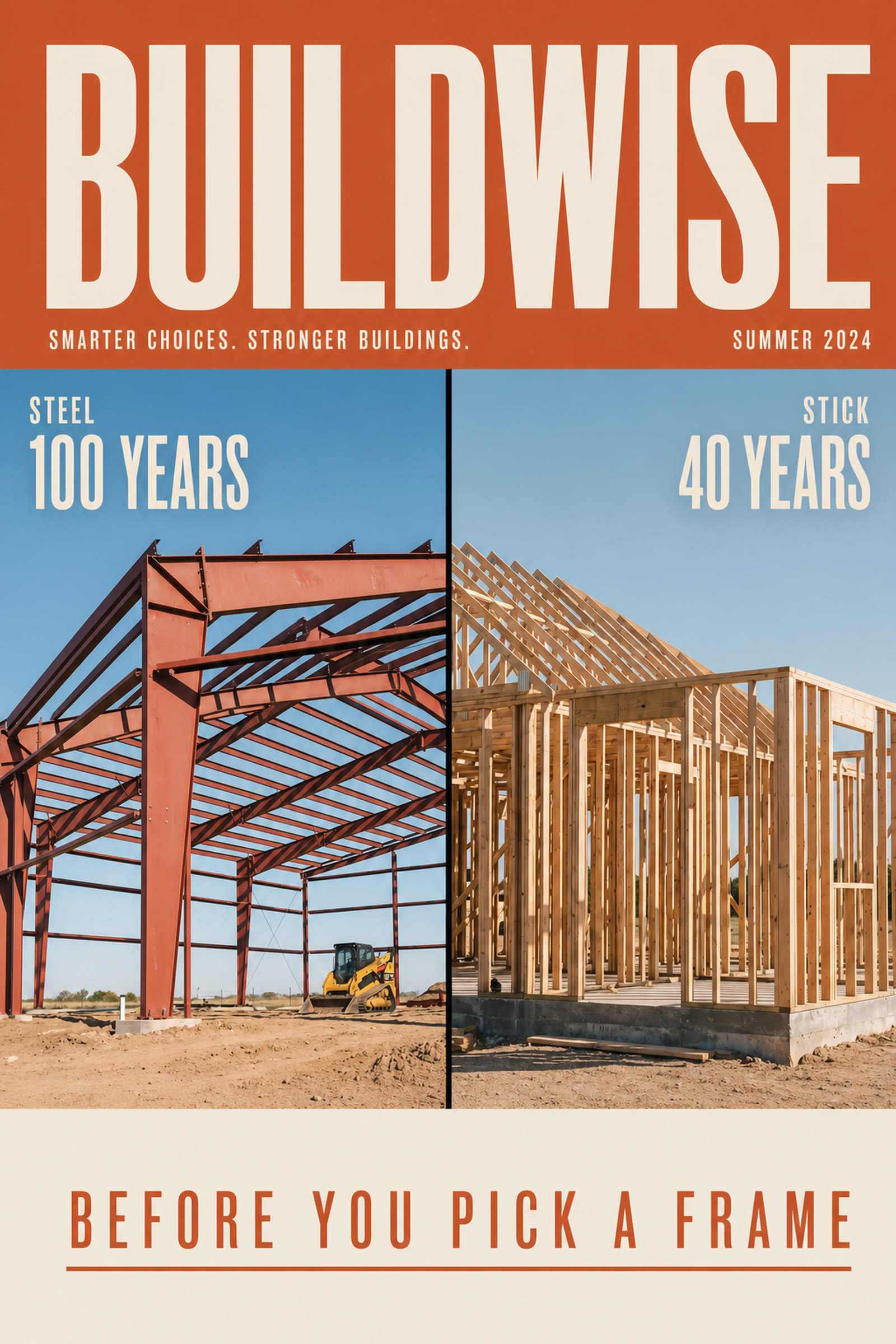
Both build good houses
Stick-frame construction has built most of the housing in this country for a century, and it does that job well. Trades everywhere know it, materials are available in every town, and appraisers have endless comparable sales.
Steel is a better answer to a specific set of problems: long clear spans, fast erection, hard sites, high shop-to-living ratios, and durability in weather. That is where we focus. If your project sits squarely in a conventional subdivision-house footprint, stick-frame is a fine choice too. This guide lays out how the two compare so you can pick with clear eyes.
Here is the honest comparison.
Cost
The structure itself is where steel is competitive. A pre-engineered rigid frame arrives as an engineered kit with predictable pricing, and it goes up in days with a small crew instead of weeks with a large one. On big open spans — a 50-foot clear width, a 16-foot eave — steel wins clearly, because achieving that in wood requires engineered trusses or beams that get expensive fast.
On a conventional 1,500 square foot single-story house with interior bearing walls and no unusual spans, the structural advantage shrinks. You may still come out ahead on speed and schedule, but do not expect a dramatic difference in framing cost.
The interior finish costs about the same either way. Cabinets, flooring, drywall, plumbing fixtures, and HVAC do not care what holds up the roof. This is why total-project cost differences are smaller than people expect: on a finished home, the frame is a minority of the budget.
Steel wins on the shell. It is neutral on the finish. If someone quotes you a barndominium at half the price of a comparable stick-framed house, look closely at what is in the finish schedule.
Speed
This is where the difference is least arguable. A red-iron frame for a 40×60 can be standing in a matter of days once the slab has cured and the steel is on site, with the roof and wall panels following immediately. The building is closed to weather early, which protects everything that comes after it.
The trade-off is on the front end. Pre-engineered steel has a lead time — the manufacturer engineers, details, and fabricates your specific building before it ships. You wait longer to start and finish faster once you do.
Durability and maintenance
Steel does not rot, does not feed termites, and does not warp. A properly detailed metal roof and wall system has a long service life, and the paint warranties on quality finishes run decades.
The failure points in a steel building are the connections and the penetrations, not the steel. Exposed-fastener panels have thousands of screws with EPDM washers, and those washers are consumable over a long enough horizon. Standing seam eliminates most roof penetrations and is the upgrade we recommend on residential roofs for exactly this reason.
Wood-framed houses have their own long-term list — rot at poorly flashed details, insect damage, and settling. Neither system is maintenance-free. Steel’s maintenance is more predictable and more visible.
Energy performance
This is the fair criticism of steel and it deserves a straight answer. Steel conducts heat far better than wood, so a steel frame creates thermal bridges at every girt and purlin. A poorly insulated metal building is genuinely uncomfortable and expensive to condition.
It is also a solved problem. Closed-cell spray foam applied to the inside of the panels, or a continuous insulation layer that breaks the bridge at the framing, produces an envelope that performs as well as or better than a conventional stick-framed wall — often better, because the air sealing is more complete.
The requirement is that you budget for it and detail it properly. Every steel-frame home we build assumes a continuous, air-sealed insulation assembly, and our pricing bakes that in so it never becomes an afterthought.
Insulation is not optional in a steel home. Plan on a continuous, air-sealed assembly — typically closed-cell foam — and treat thermal bridging at the framing members as a design item, not an afterthought.
Insurance
Steel buildings are non-combustible and hold up well in wind, which insurers generally like. Most major carriers in rural Missouri, Arkansas, Oklahoma, and Tennessee now write residential policies on steel-frame homes without any drama, and the market keeps improving as the building type becomes more common.
The one thing worth doing: call an agent before you build and confirm they write residential policies on steel-frame homes. Any experienced rural agent in our four states can point you to a carrier that does.
Resale and appraisal
The market for steel-frame homes has grown substantially, but it is still thinner than the market for conventional homes, and thin markets mean fewer comparable sales. That affects appraisal on your construction loan and on your buyer’s mortgage when you sell.
What helps: finished residential quality inside, residential-style windows and entries, a proportionate shop-to-living ratio, and not over-improving relative to the county. What hurts: a building that reads as a warehouse with a bedroom in it.
Our financing guide goes deeper on the appraisal issue.
Where each one wins
Choose steel when you need long clear spans, tall eaves, a large shop or equipment area, fast dry-in on a hard site, or a building type that combines living and working space. Choose it when durability and low structural maintenance matter to you over decades.
Choose stick-frame when you are building a conventional house on a conventional lot in a subdivision, when you need maximum appraisal certainty, when complex rooflines and traditional architecture are the goal, or when you want local trades who have built the same thing a thousand times.
We build steel because it is what we are good at and because the buildings our customers want — shops, barndominiums, event buildings, lake houses on hard ground — are the buildings steel does best. Send us the parcel and the program and we will map out whether steel is the right fit.